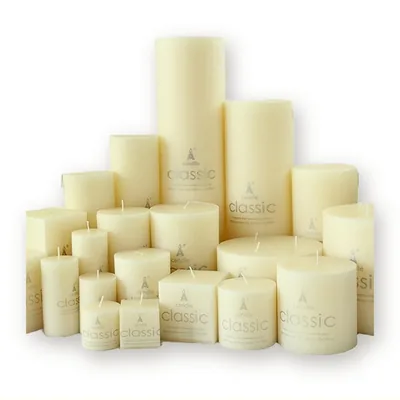
Start with the product brief
Before you ask for samples, decide what the candle is for and where it sells. A gift-shop candle in a ribbed glass jar with a wooden lid is a different product from a supermarket tealight pack. Write down:
- Format: container candle, pillar, taper, tealight or shaped candle.
- Target retail price and how it will be displayed.
- Scent family and how many scents in the range.
- Packaging: label only, sleeve, or rigid gift box.
- Countries of sale, because labels must be in their languages.
Wax: soy, blends and paraffin
The wax drives burn behaviour, scent release and cost.
| Wax | Typical use | Points to check |
|---|---|---|
| Soy wax | Container candles | Soft, can frost or show wet spots on glass; check the surface on the sample |
| Soy or rapeseed blends | Container candles | Blend ratio affects hardness and scent load; ask for the exact composition |
| Paraffin | Pillars, tapers, tealights | Hard and economical; common for unscented and dinner candles |
| Beeswax | Tapers, honeycomb candles | Natural honey scent, higher price; ask for the share of beeswax if blended |
Avoid marketing claims about the wax that you cannot document. "Soy wax" on a label should mean the wax is soy wax, and the supplier should state the blend in writing.
Wick and jar
The wick must match the wax, the fragrance and the jar diameter. Too small and the candle tunnels; too large and it soots and the jar overheats. Ask the factory which wick series and size they use, and test the sample for a full melt pool and stable flame over several burns.
Jar choice matters as much as the wax. Thick-walled glass and ceramic vessels are common. Check the wall thickness, the base, and whether the vessel has been used with this wick before. Glass and ceramic jars need inner boxes and dividers for transport, as with any glassware.
Fragrance load and documents
Fragrance is usually added at a few percent of the wax weight. More fragrance does not always mean more scent throw, and it can affect burning. Any promise on scent throw or burn time should be stated only as per supplier data and confirmed on the sample.
For each scent, request from the factory:
- The fragrance supplier's safety data sheet (SDS).
- The IFRA conformity document for the fragrance at the stated dosage in candles.
- A list of declarable allergens and their concentration in the finished candle.
CLP labelling for scented candles
Some fragrance mixtures contain substances that trigger hazard labelling under the CLP Regulation (EC) 1272/2008. Depending on the fragrance and the dosage, the candle may need a pictogram, a hazard statement such as "May cause an allergic skin reaction" or an allergen statement, plus the supplier's contact details. Whether this applies is calculated from the SDS, so the label cannot be designed before the scent is fixed.
This is one reason why changing a scent late in the project delays production: new documents mean a new label.
Candle safety standards
The GPSR requires candles to be safe, and European standards are the usual way to show it:
- EN 15494 sets out the safety label for candles: warning symbols and texts such as never leaving a burning candle unattended, keeping away from things that catch fire, and out of reach of children and pets.
- EN 15426 describes how sooting behaviour is assessed.
- EN 15493 covers fire safety of candles, such as flame height and secondary ignition.
These are voluntary standards. We request the manufacturer's test reports against them where available, and the safety label is printed in the languages of each market.
The GPSR label
On top of the candle safety symbols, every candle needs the importer's name, postal and e-mail address, a type or batch reference and instructions in the language of the country of sale. Online listings need the same data. With private label, your brand appears on the front and we appear as the EU importer on the label.
Packaging and gift boxes
Packaging often costs as much attention as the candle. Decide early between a simple label on the jar, a printed sleeve and a rigid box with an insert. A rigid box protects the jar and lifts the price point, but needs its own artwork proofs and production time.
- Leave space on the base or the back label for the safety symbols, the GPSR data and any CLP statement.
- Print the barcode (EAN) on the box and on the jar, so the shop can scan either.
- Use one label layout for all scents and change only the scent name and colour, so that adding a scent later is quick.
- Check packaging EPR registration for each country, for example LUCID in Germany.
Heat and transport
Candles soften in heat. Containers on summer routes can get very hot, and soy wax in particular can deform, sweat or lose its smooth surface. Plan Q4 candle shipments so that they do not sit in a port in the hottest weeks, keep pillars and tapers upright in cartons with dividers, and inspect the surface on arrival. If a candle does frost or show wet spots, it usually still burns normally, but agree in advance what is acceptable for your shop.
Samples and approval
- Choose wax, jar and scent from the factory's range.
- Receive samples in about 7–14 days and burn them at home or in the shop for several sessions.
- Fix the scent, the label artwork and the box.
- Approve a pre-production sample with the final label.
- Production in about 25–45 days, then inspection with a burn test on a sample from the batch.
Private label candles start from 300 pieces per scent and format. Our private label page describes the steps, and the candles category shows the base products. If you sell candles with holders or lanterns, see candle holders for matching items.