Which products need a fibre label
The Textile Labelling Regulation (EU) 1007/2011 applies to textile products made available on the EU market. A product counts as a textile product if at least 80 % of its weight is textile fibre. In a home range that covers:
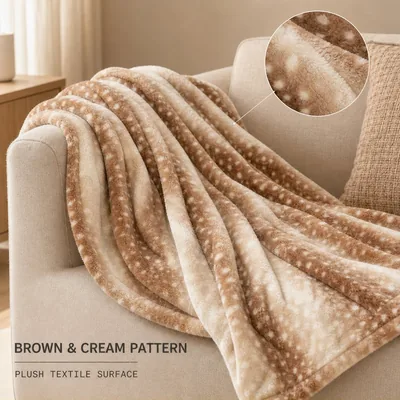
- Throws, blankets and bedspreads.
- Cushion covers and filled cushions.
- Bed linen, duvet covers, comforters and quilts.
- Towels, bathrobes and kitchen towels.
- Curtains, voiles and café curtains.
- Table linen: tablecloths, runners and fabric placemats.
Some items are textile products only in part. The textile components of furniture upholstery, and the pile layer of rugs and carpets, must also be labelled for fibre composition. Fabric storage boxes and laundry hampers are worth checking case by case.
This is a practical overview, not legal advice. Check the regulation and your national rules before you print labels.
What the fibre label must say
- Fibre names from the regulation. Only the names listed in Annex I may be used: cotton, linen, wool, polyester, viscose, polyacrylic and so on. Trade names alone are not enough.
- Percentages by weight, in descending order. Small amounts may be grouped as "other fibres" within the limits of the regulation.
- Language. The label must be in the official language or languages of the member state where the product is sold.
- Durability. The label must be durable, easily legible and visible. A sewn-in label is the usual choice, though packaging may be used in certain cases.
- Non-textile parts of animal origin. If the product contains leather or similar parts, the label must say "contains non-textile parts of animal origin".
Common mistakes
| Label text | Problem | Correct approach |
|---|---|---|
| "Faux fur" only | Not a fibre name | Fibre name, for example 100 % polyester |
| "Bamboo" | Usually a viscose fibre made from bamboo | The fibre name, usually viscose |
| "Microfibre" | Describes the fibre size, not the fibre | The fibre name, often polyester or polyamide |
| "Cotton blend" | No percentages | For example 60 % cotton, 40 % polyester |
| English only | Wrong language for the market | Languages of every country of sale |
Fibre content should be checked, not only declared. Ask the factory for a fibre composition test on a production sample, and compare the label with the order at inspection.
Care symbols
Care labelling is not required by EU law, but retailers expect it, and customers return items that shrink or bleed after the first wash. The common care symbols are a registered system, so use them as specified. State washing temperature, drying, ironing and dry cleaning according to the supplier's data, confirmed on the sample.
Washable rugs and bath mats deserve particular care: the backing and the pile may behave differently in the machine. Test them in the conditions on the label before you approve the care text.
Selling in several countries
A range sold across Europe needs labels in many languages, and some countries have more than one official language: Belgium and Switzerland are the usual examples. There are three common solutions:
- Multilingual sewn-in label. A booklet or a long label with all languages. It suits bed linen and towels, where the label is hidden.
- Short sewn-in label plus packaging. Fibre composition in several languages on a small label, with care and safety texts on the insert card or band.
- Market-specific labels. Separate production runs per country. This gives the cleanest label but raises the minimum per version.
Decide this before you order, because the label is sewn in during production and cannot be changed in the warehouse. Fibre names are standardised across languages in the regulation, which makes translation straightforward.
The GPSR data
The General Product Safety Regulation applies to home textiles like any other consumer product. Each item, or its packaging, needs:
- The name, postal address and e-mail of the manufacturer and of the EU importer.
- A type, batch or model number.
- Warnings and instructions in the language of the country of sale, for example on the risk of polybags, or how to fix a curtain rod.
For distance sales the same information must appear online. With private label, your brand goes on the label and we appear as the EU importer.
REACH and dyes
REACH (EC) 1907/2006 restricts certain substances in textiles. Examples are azo dyes that can release certain aromatic amines, and certain substances in coatings and prints. For printed cushions, dyed bed linen and coated tablecloths, REACH checks against the relevant restrictions are available on request, before mass production.
OEKO-TEX labels are private schemes. A product can only be described with such a label if the manufacturer holds a valid certificate for that article, and you have seen it. Do not add a label to packaging because a fabric supplier once showed a certificate.
No fire claims
Curtains, throws and upholstery are sometimes sold with claims about fire behaviour. We do not make such claims for any product, and we do not supply furniture or textiles against the separate fire-safety rules for upholstered furniture in the UK and Ireland. If a hotel or a public building needs specific fire classes for curtains, that is a project specification, and the documents must come from a test for that exact fabric.
Practical checklist
- Confirm fibre composition with the factory and get it in writing.
- Prepare the label in all languages of sale.
- Add care symbols per supplier data, confirmed on the sample.
- Add GPSR data and a batch number.
- Check the label against the goods at inspection.
Our quality page explains what we check, and the throws and cushions, bed and bath and curtains categories show the products we supply.